Strategic Furniture Sale Instagram Post Templates: A Practical Guide for Better Marketing Results
In the crowded digital marketplace, a furniture sale is more than just a transaction; it's a visual story waiting to be told. The difference between a sale that merely moves inventory and one that builds brand equity often lies in the quality of its presentation. This is where professional Furniture Sale Instagram Post Templates transition from a simple design tool to a strategic asset. For entrepreneurs, marketers, and creators, these templates offer a direct path to polished, consistent, and high-converting social media content without the need for a dedicated design team or extensive technical skills.
Understanding the Strategic Value of Pre-Designed Templates
At its core, a Furniture Sale Instagram Post Template is a pre-structured graphic file designed for immediate customization. However, viewing it merely as a time-saver underestimates its potential. Strategically, it serves as the foundation of your visual brand language during a campaign. Consistent use of professional, clean, and modern templates across Instagram, Facebook, and LinkedIn reinforces brand recognition. When your audience sees a cohesive aesthetic—uniform colors, fonts, and layout styles—they begin to associate that quality with your business, building trust and professionalism before they even read a word of your sale copy.
The true power lies in intentionality. A well-chosen template set guides the customer's eye, highlights the product, and communicates the offer with clarity. It removes the guesswork and common design pitfalls that can make a sale look amateurish or desperate. Instead, it positions your brand as authoritative and curated, which is particularly crucial in the home goods and furniture space where taste and trust are paramount.
Aligning Templates with Your Campaign Goals and Planning
Before downloading a single file, the most important step is to define your goal. Are you clearing out old inventory to make room for new collections? Are you launching a seasonal promotion to boost quarterly revenue? Or are you using a sale to attract new customers into your ecosystem? Your objective will dictate which templates you select and how you customize them.
For a brand-clearance sale, you might prioritize bold, urgent designs with strong discount callouts. A template with a prominent "SALE" banner and ample space for slashed prices would be ideal. Conversely, a seasonal promotion for a new sofa collection might benefit from more lifestyle-oriented templates. Here, the focus shifts from price to ambiance. You would choose templates that allow for larger image areas, perhaps with a clipping mask for a seamless product placement, and more elegant, less aggressive typography. Planning your content calendar in advance allows you to mix these types strategically—using urgent posts to drive immediate action and aspirational posts to maintain brand value.
Practical Customization: From Generic to On-Brand
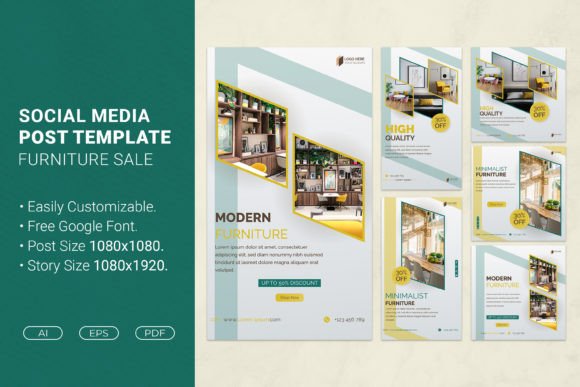
The included file formats—Adobe Illustrator, EPS, and PDF—along with features like editable text, images, and colors, are where the practical work begins. The goal is to transform a generic, professional template into a unique piece of your brand's content.
Start with the fundamentals:
- Color Palette: Immediately change the template's colors to your brand's primary and secondary palette. This single step does the most to make the design yours.
- Typography: The templates include free fonts, but ensure they align with your brand's voice. If your brand is minimalist, a clean sans-serif is perfect. If it's more traditional, a classic serif might be necessary. Document these choices for consistency.
- Imagery: Utilize the simple clipping mask feature to place your own high-resolution product photography. The quality of your images is non-negotiable; the template exists to frame them, not compensate for them. Ensure your photos are well-lit, staged, and showcase the furniture from its best angle.
Beyond the basics, consider the message hierarchy. A template might have placeholder text for "Headline," "Subhead," and "Details." Use this structure intentionally. The headline should be your primary hook (e.g., "Summer Living Room Event"). The subhead can add context or a secondary benefit ("Refresh Your Space for Less"). The details section is for the non-negotiable information: the percentage off, dates, website URL, or store location.
Decision-Making: When to Use Templates and When to Invest Elsewhere
Templates are a powerful tool, but they are not a universal solution. They are most effective for recurring needs: weekly promotions, flash sales, new arrival announcements, and seasonal campaigns. They provide the consistency and speed required for a sustainable social media operation. For a small business owner or a freelancer, this efficiency is invaluable, freeing up time to focus on sourcing products, customer service, and other core operations.
However, there are moments to consider a different approach. A major brand repositioning, a one-time flagship store opening, or a collaboration with a high-profile designer might warrant a fully custom campaign created by a professional graphic designer. The template is the workhorse for your ongoing marketing engine; the custom project is the special event that might define a quarter or a year. The key is to assess the scale, audience, and long-term impact of the campaign before deciding.
Mitigating Risks and Avoiding Common Pitfalls
The greatest risk of using templates is not in the tool itself, but in its application. Relying on templates without a clear brand strategy can lead to a disjointed and confusing online presence. If every post uses a wildly different color scheme or font because you're choosing templates randomly, you erode the very consistency you aimed to build.
Another pitfall is neglecting the user experience. A beautifully designed post is useless if the call-to-action is unclear or the link in your bio leads to a generic homepage. Ensure every template is part of a coherent customer journey. The post should clearly state the offer, and the link should direct users to a specific landing page, collection, or product page relevant to the sale.
Finally, avoid the "set it and forget it" mentality. While templates save design time, they don't replace strategic thinking. Monitor your post performance. Which template styles—bold and discount-focused versus elegant and lifestyle-focused—generate more engagement, clicks, or conversions? Use this data to refine your choices for the next sale, creating a cycle of continuous improvement.
Integrating Templates into a Long-Term Brand Strategy
Viewing Furniture Sale Instagram Post Templates as a component of your long-term brand strategy transforms their value. They become part of your brand's visual toolkit, much like your logo or color guide. Over time, your audience will come to recognize and respond to your specific template adaptations. This recognition reduces the cognitive load for your followers; they instantly know it's your brand and what to expect, which is a powerful psychological advantage in a busy feed.
For educators, bloggers, or publishers in the design and home niche, these templates can also serve as a teaching tool or a resource to share with your audience, further establishing your authority. For small business owners, they level the playing field, allowing you to present your offerings with the same visual polish as larger competitors.
In conclusion, professional furniture sale templates are far more than clip art for social media. Used with intention, they are a strategic lever for achieving better marketing results. They support planning, ensure brand consistency, enhance productivity, and ultimately contribute to a more professional and trustworthy customer experience. The key is to approach them not as a quick fix, but as a foundational element of a thoughtful, goal-oriented digital marketing practice. By customizing them purposefully and integrating them into your broader strategy, you ensure that every sale post does more than just advertise a product—it builds your brand.